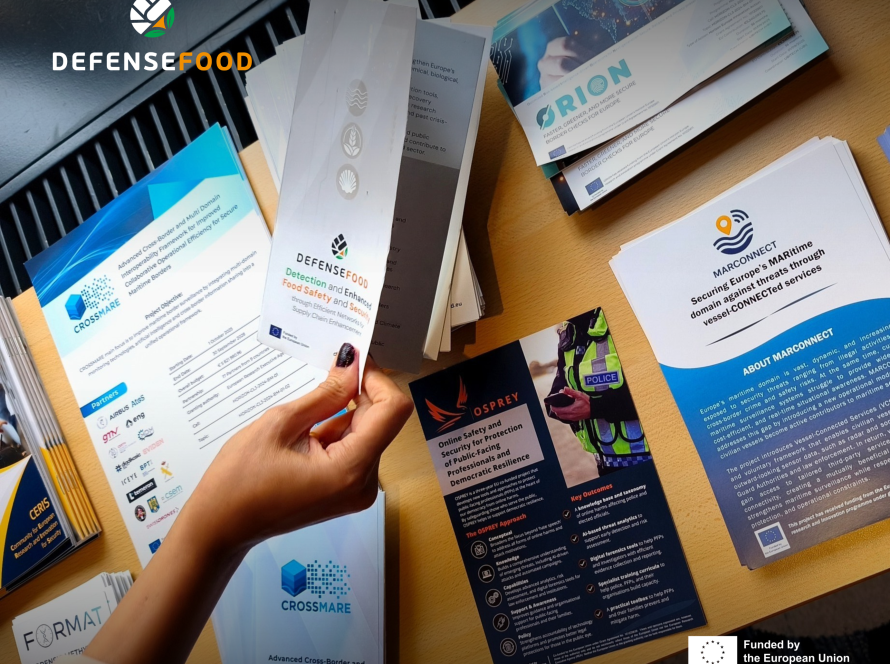

On 13-14 October 2025, the DEFENSEFOOD Horizon Europe project officially launched with a Kick-off Meeting held at Wageningen University in the Netherlands. Guided by the motto, “Defending the food systems through science and innovation”, the project aims to enhance the resilience of Europe’s food supply chain against chemical, biological, and radiological (CBR) threats, ensuring robust preparedness, rapid response, and effective recovery.
A concept, more relevant than ever
Today’s food systems are complex and vulnerable. In a landscape that constantly changes politically, technologically, and socially, the idea of securing these systems against threats becomes more relevant than ever. Food fraud and adulteration are common, but food safety systems are not designed to handle systemic or malicious incidents. “DEFENSEFOOD‘s holistic approach seeks both to invest in food threat prevention and to develop a dynamic system capable of adapting and responding to emerging threats, thereby ensuring direct and effective protection of food systems”, stated Natalie Masters, representing the project coordinator, Sustainable Criminal Justice Solutions.
Multidisciplinary consortium full of expertise
Thirteen partners from nine countries gathered in the Netherlands to officially launch the project, focusing on a scientific approach designed to make a meaningful impact on society.
DEFENSEFOOD brings together a strong group of experts, including:
▪ Research institutes and public organisations with extensive work and expertise on food safety and applied research: Syreon Research Institute (Hungary), Wageningen University and Research, Wageningen Food Safety Research, National Institute for Public Health and the Environment, Netherlands Food and Consumer Product Safety Authority (The Netherlands), Sciensano (Belgium), McGill University (Canada), National Research Council (Italy), Spanish Food and Drink Industry Federation (Spain), Fraunhofer (Germany),
▪ Security and defense experts: Sustainable Criminal Justice Solutions (United Kingdom), University of the Bundeswehr Munich (Germany),
▪ Sustainability and green tech experts: Ubuntoo (the Netherlands),
▪ Dissemination, exploitation, and communication leaders: reframe.food (Greece).
Focusing on vulnerabilities
The project examines the entire food chain to understand where risks could appear and how they can be managed effectively. In addition, it focuses on three critical case studies (cereals, shellfish, and water supply), which are essential to public health and particularly vulnera-ble to contamination. To address these risks, the project aims to sup-port the production, processing, and distribution of food by:
▪ developing AI-enabled risk identification and decision-making tools
▪ raising awareness among authorities, the food industry, producers, and consumers about potential food-related risks,
▪ providing training and guidance to help stakeholders respond confidently and effectively during crises (through an AI-powered knowledge platform and learning tools)
▪ sharing best practices across countries to improve European food systems’ collective resilience
To achieve these goals, DEFENSEFOOD combines practical strategies with predictive analytics, laboratory techniques, and simulation models. This combination enables faster detection, more accurate assessment, and informed decision-making, ensuring that threats are contained and that supply chains recover swiftly.
Making a real impact by safeguarding food security
By integrating scientific innovation, cross-border collaboration, and advanced technologies, the project sets a new standard for safeguarding Europe’s food systems, empowering stakeholders to anticipate, detect, and respond to threats effectively. Its work ensures that communities, economies, and public health are better protected, creating a resilient food supply chain for today and the future.
Follow us on social media: Facebook | LinkedIn | X

Funded by the European Union. Views and opinions expressed are however those of the author(s) only and do not necessarily reflect those of the European Union or Research Executive Agency. Neither the European Union nor the granting authority can be held responsible for them.